
Hiatus Hernia
Hiatus Hernia Surgery in Sydney: Expertise by Dr. Robert Gandy
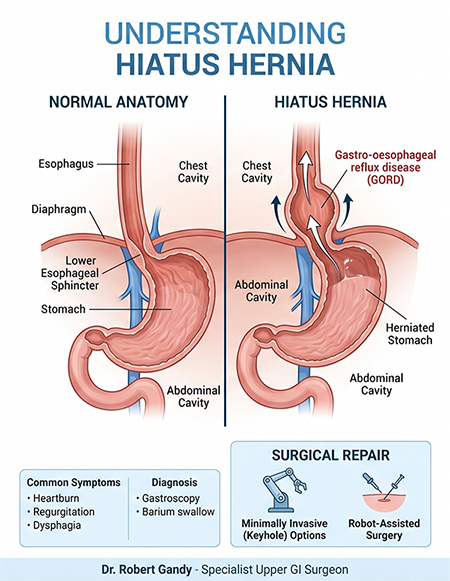
A hiatus hernia occurs when the upper part of your stomach pushes through the diaphragm and into the chest cavity. While small hernias often go unnoticed, larger ones can significantly impact your quality of life.
What are the Symptoms?
Many people with small hiatus hernias remain asymptomatic. However, as the hernia grows, you may experience:
- GORD (Gastro-oesophageal reflux disease):Chronic heartburn and acid reflux.
- Regurgitation:Food or stomach acid coming back up into the throat.
- Dysphagia:Difficulty swallowing or a sensation of food getting "stuck."
- Severe Cases:Vomiting or sharp pain caused by the stomach twisting (volvulus).
Under the care of Dr. Robert Gandy, a specialist surgeon with over 20 years of surgical experience and a decade-long dedicated practice in Sydney, patients receive world-class care utilizing the latest minimally invasive techniques.
Understanding Hiatus Hernia Symptoms
Many patients with small hernias are asymptomatic. However, as the hernia enlarges, it can lead to:
- GORD (Gastro-oesophageal Reflux Disease):Persistent heartburn and acid reflux.
- Regurgitation:The sensation of food or acid returning to the throat.
- Dysphagia:Difficulty swallowing or the feeling of food getting "stuck" in the chest.
- Severe Complications:In rare cases, the stomach can twist (volvulus), causing sharp pain or vomiting—this requires immediate medical attention.
Diagnosis and Pre-Surgery Mapping
To ensure the highest surgical precision, Dr. Gandy utilizes a comprehensive diagnostic suite:
- Gastroscopy:Direct inspection of the esophagus and stomach lining.
- Barium Swallow:An X-ray to determine the exact size and anatomical position of the hernia.
- Manometry & pH Testing:Vital for measuring esophageal function and acid levels to tailor the surgical approach.
- CT Scan:Reserved for complex or giant hernias to map surrounding structures.
Surgical Treatment Options
When lifestyle changes and medications fail, surgery offers a long-term solution. Dr. Gandy specializes in minimally invasive repairs that prioritize faster recovery and minimal scarring.
Laparoscopic (Keyhole) & Robotic Surgery
All repairs are now performed using Keyhole surgery, involving 4–5 tiny incisions.
- The Da Vinci Robot:Most Cases do not require robotic surgery and conventional laparoscopy is often superior. The Da Vinci robot can offer advantages in complex anatomical cases.
- Bioabsorbable Mesh:For very large gaps in the diaphragm, Dr. Gandy may use a modern bioabsorbable mesh. Unlike older permanent meshes, this acts as a scaffold for your own tissue to grow into before safely dissolving.
- Fundoplication:To prevent future reflux, the top of the stomach is often "wrapped" (fundoplication) to reinforce the anti-reflux valve.
Recovery Timeline: What to Expect
Following a structured recovery plan is essential for the long-term success of the repair.
|
Period |
Activity Level |
Dietary Requirements |
|
Days 1–2 |
Hospital monitoring |
Clear liquids only |
|
Week 1 |
Gentle walking at home |
Soft Diet: No large chunks, bread, or raw veg |
|
Week 2 |
Return to light office work |
Continue soft diet; avoid carbonated drinks |
|
Week 4 |
Jogging, swimming, and gym |
Gradual return to a normal diet |
|
Week 6 |
Heavy lifting/manual labor |
Normal diet fully resumed |
Post-Surgery "Soft Diet" Guide
The "Golden Rules" for a successful recovery:
- Eat Slowly:Aim for 20–30 minutes per meal.
- Chew Thoroughly:Food should be the consistency of applesauce before swallowing.
- Stop Early:Stop eating the moment you feel full to avoid stretching the repair.
- No "Fizzy" Drinks:Avoid carbonated water, soda, or beer for at least 4 weeks to prevent painful gas buildup.
Dietary Stages
|
Stage |
Timeline |
What to Eat |
|
Stage 1: Liquids |
Days 1–2 |
Water, clear broth, apple juice, tea, and protein water. |
|
Stage 2: Puree |
Days 3–7 |
Smooth soups (no chunks), Greek yogurt, protein shakes, mashed avocado, and smooth congee. |
|
Stage 3: Soft Foods |
Week 2 |
Scrambled eggs, well-cooked pasta, poached fish, mashed potatoes, and steamed soft vegetables. |
|
Stage 4: Normal |
Week 3+ |
Gradually reintroduce solid foods. Introduce "tougher" items like steak or crusty bread last. |
Foods to Avoid (First 14 Days)
- Dry/Tough Meats:Steak, pork chops, or dry chicken breast.
- Doughy Bread:Fresh white bread can "clump" and get stuck.
- Raw Vegetables:Carrots, celery, or salads.
- Skin & Seeds:Tomato skins, grape skins, or nuts.
- Carbonation:Anything with bubbles.
Frequently Asked Questions (FAQ)
Is a hiatus hernia a medical emergency?
Usually, no. However, sudden, severe chest pain or the inability to swallow or pass gas can indicate a strangulated hernia, which requires emergency care.
Is the mesh used in surgery permanent?
Dr. Gandy typically uses bioabsorbable mesh. It provides temporary reinforcement and eventually dissolves once your natural tissue has strengthened the repair site.
Can the hernia come back?
Recurrence is possible, particularly with giant hernias. Dr. Gandy’s use of modern tension-free techniques and fundoplication significantly reduces this risk.
Why Choose Dr. Robert Gandy for Your Repair?
Selecting an experienced surgeon is the most critical factor in reducing the risk of hernia recurrence and complications.
- Decade of Specialization:10 years of specialist practice focusing on Upper GI and laparoscopic surgery.
- Proven Track Record:Over 20 years of total surgical experience, including advanced training and clinical research.
- Robotic & Laparoscopic Leader:Expert in both Da Vinci Robotic-assisted surgery and traditional "keyhole" techniques.
- A Patient-Centred Approach:We empower our patients to be active participants in the decision-making process. By listening to your specific needs and concerns, we tailor every procedure to ensure the best possible clinical outcome.
Costs and Insurance
- Medicare (Public):Available for Australian residents in public hospitals (waitlists apply).
- Private Patients:Most private health funds cover hiatus hernia repairs. We provide a transparent, full written quotation regarding surgical fees and out-of-pocket expenses prior to your procedure.